
Miang: The Dish That Brings the Most Fun and the Most Learning


Among the many dishes introduced in our DTV cooking program, Miang stands out as one of the most enjoyable and memorable experiences for students. At first glance, Miang may appear simple, a wrap made with fresh leaves and a selection of fillings. However, once students begin preparing and assembling it themselves, they quickly discover that Miang offers much more than flavor. It provides a deeper understanding of how Thai and Southeast Asian food culture values balance, interaction, and shared experience.
Unlike plated dishes that are prepared once and served the same way to everyone, Miang invites participation. Each person builds their own wrap, makes their own choices, and experiences the dish slightly differently. This interactive nature immediately creates energy in the kitchen and makes Miang one of the most engaging dishes students work with.
What Makes Miang Special
Traditionally, Miang is served using fresh leaves as the wrap, filled with a variety of ingredients that each play a specific role in the final bite. Rather than being pre-assembled, Miang is intentionally designed to be built by the person eating it. This allows for personal preference, creativity, and experimentation, an important characteristic of Thai food culture.
In our program, students work with key ingredients such as:
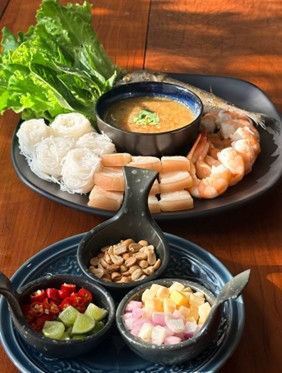
Pla Too (mackerel), providing savory depth and richness
Moo Sam Chan (pork belly), adding texture and a satisfying balance of fat and meat
Kung (shrimp), contributing light sweetness and freshness
By combining these ingredients themselves, students begin to understand how Thai cuisine often uses contrasting proteins together rather than relying on a single dominant flavor. Each bite becomes a lesson in contrast: rich and light, savory and fresh, soft and firm working together in harmony.
Learning Balance Through Sauce Making
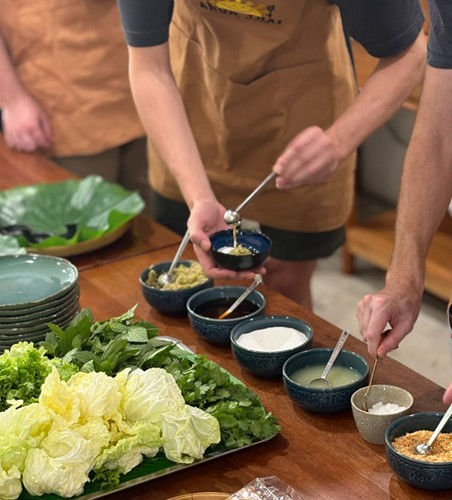
One of the most engaging and educational aspects of preparing Miang is the sauce. Instead of following a fixed formula, students are encouraged to taste, adjust, and refine. This approach reflects a fundamental principle of Thai cooking: understanding flavor logic is more important than memorizing recipes.
As students adjust sweetness, saltiness, acidity, and heat, they learn that balance is personal. There is no single “correct” taste, only a balance that feels right to the person eating it. This lesson is especially valuable because it can be applied across many Thai dishes, not just Miang.
Through this process, students gain confidence in their own judgment. They learn to trust their palate, understand cause and effect in seasoning, and develop skills that extend far beyond a single class session.
A Reflection of Thai Food Culture
Miang naturally creates a lively atmosphere in the kitchen. Although each student prepares their own wrap, the dish encourages conversation, sharing, and comparison. Students often discuss how they adjusted their sauce, which ingredients they preferred, or how their flavor balance differs from others.
This mirrors how food is traditionally enjoyed in Thailand not as an individual activity, but as a social experience. Meals are often shared, interactive, and flexible, with each person participating rather than simply consuming.
By learning dishes like Miang in a structured setting, students become familiar with:
Communal eating traditions
The cultural role of fresh leaves, herbs, and seasonal ingredients
The importance of adaptability and personal taste in Thai food
These elements help connect practical cooking skills with a broader understanding of Thai culture and everyday life.
How This Benefits Our Students
Experiences like Miang offer far more than a fun class. For DTV students, this kind of structured cultural learning provides lasting value throughout their time in Thailand. By engaging directly with traditional dishes, students develop a deeper understanding of Thai food and daily lifestyle, gained through hands-on practice rather than observation alone.
The process builds confidence as students learn how to balance flavors, prepare ingredients correctly, and make thoughtful adjustments. These skills extend well beyond a single dish and help students feel more comfortable exploring Thai food on their own.
Cultural learning is most meaningful when it is experienced, not explained. The video features one of our students reflecting on his time in the program and what he gained from learning Thai cuisine through practice.

Lastly, check out our “DTV program December Workshop” and “How to eat Miang tutorial” videos to better understand Miang, its ingredients, and how it’s enjoyed.
This dish is one example of the cultural learning approach used in our DTV Thai Cooking Program at Arun Thai Cooking School.


Comments